TraqNext burnout prevention report spots burnout risks early. It looks at context-switching fatigue, digital exhaustion, after-hours activity, and declining focus. These insights can help managers address risks before they contribute to performance crises.
Explore today - full access, no credit card required!

Burnout isn't caused by hard work — it happens when employees can't disconnect. The Work-Life Balance Heatmap tracks after-hours activity to identify employees at risk before burnout takes hold.
The TraqNext Work-Life Balance Heatmap tracks employee activity after working hours, making after-hours work monitoring a visible, manageable metric rather than a hidden risk. Burnout isn’t about working hard. It comes from staying connected to work all the time. The system detects off-hours activity and shows it in a heatmap. This highlights when employees can’t disconnect.
TraqNext spots employees working after hours. It sends a break reminder and notifies their manager to prevent burnout.

High cognitive load from jumping between apps leads to faster burnout. The Context-Switching Fatigue Index measures focus patterns to identify where employees are scattering their energy.
Task switching leaves "attention residue" that accumulates and drives burnout. The Context-Switching Fatigue Index counts how often employees switch tasks or apps — displayed as switches per hour — so managers can spot which work patterns are draining focus and energy.
The data appears in a Radar (Spider) Chart, with each point showing a different focus area. A balanced radar shows an employee working with focus. A jagged radar shows frequent task switching. Managers can use this to spot overloaded employees and adjust their work.

A strong burnout warning: when work hours remain high but output drops, employees are likely burning out. The Focus vs. Fatigue Trend gives managers an output-per-hour view to catch this pattern early.
The "Focus vs. Fatigue" Trend is a powerful burnout predictor. It compares time spent on tasks to the actual output produced. This chart shows active work time on one line and productivity speed on another. It gives a visual view of work efficiency over time.

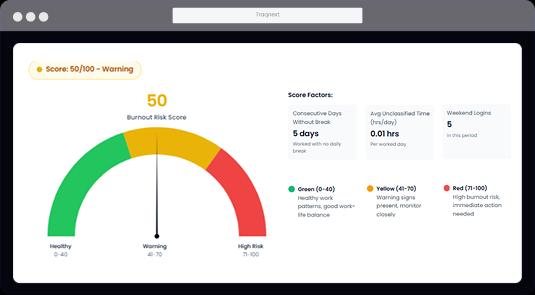
A unified 1–100 burnout risk score that aggregates many data points. From green (healthy) to red (high risk).
The Digital Exhaustion Score in TraqNext combines multiple burnout signals — missed breaks, app usage intensity, and weekend work — into a single 1–100 risk score, colour-coded from green (healthy) to red (high risk). It tracks breaks missed, app usage, and weekend work to give a clear picture of digital exhaustion.
Managers can see each individual's burnout risk score immediately, and view team-level burnout risk to identify which departments are in the red — enabling targeted workload adjustments and timely support for struggling employees. This helps them balance workloads and support struggling teams. The data also guides decisions on resources and project deadlines.

TraqNext analyses burnout risk from multiple aspects: the Context-Switching Fatigue Index tracks how often employees switch tasks; the Digital Exhaustion Score combines break patterns, weekend work, and app intensity into a 1–100 risk score; the Focus vs. Fatigue Trend compares hours worked to output produced; and the Work-Life Balance Heatmap monitors after-hours activity. Together, these signals give managers early warning before burnout affects performance.
Look for software that tracks behavioral warning signs rather than hours alone. Useful signals include after-hours and weekend work, missed breaks, frequent app or task switching, and long hours paired with falling output. TraqNext turns these signals into four views: a Work-Life Balance Heatmap, a Context-Switching Fatigue Index, a Focus vs. Fatigue Trend, and a 1–100 Digital Exhaustion Score that runs from green to red. Managers can see individual and team-level risk before performance drops.
Context-switching fatigue occurs when frequent task and app switching prevents deep focus, creating cognitive load that accumulates into burnout. TraqNext measures this as switches per hour and displays the data in a Radar Chart — a balanced radar indicates focused work, a jagged radar signals excessive task-switching and potential overload.
Yes. TraqNext shows burnout risk at both the individual and team level. The Digital Exhaustion Score highlights which departments are in the red, enabling managers to balance workloads proactively, reassign tasks, and set realistic project deadlines before burnout impacts delivery.
See burnout risk for your team — start free
Explore today - full access, no credit card required!
Learn more about using this feature