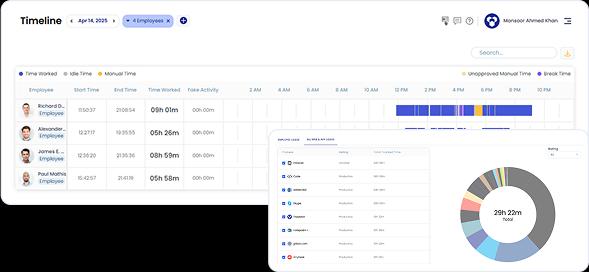
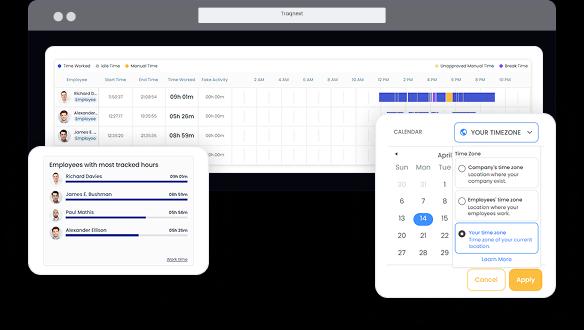
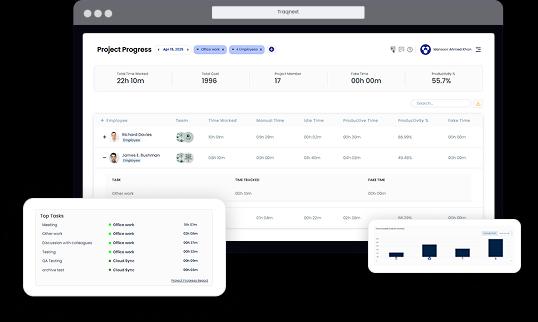
TraqNext automatically tracks every work session — start, stop, break, and idle — giving you accurate timesheets without manual input. Compare actual hours against scheduled time to spot systematic over- or under-utilisation across teams.
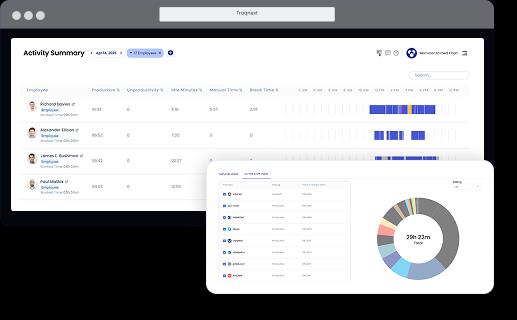
Explore Time Tracking →The Activity Summary shows exactly which tools employees use during work hours and assigns each a productivity score. You can see at a glance whether the team is deep in project work or drifting toward low-value browsing — without surveillance-style monitoring.
Explore Activity Monitoring →Project Progress reports display total tracked time, cost against project or employee billing rates, and activity trends over the last six months. Finance and ops teams get a single source of truth for project profitability.
Billing & Invoicing Use Case →Idle Time and Break Time reports distinguish genuine rest from unproductive drift. When idle spikes cluster around specific times, tools, or individuals, you have a data-backed starting point for process improvement — not a blame conversation.
Insights & Reporting →Predictive Burnout Analysis monitors employee wellbeing from multiple aspects — Context-Switching Fatigue, Digital Exhaustion Score, Focus vs. Fatigue Trend, and Work-Life Balance Heatmap. Sustained inefficiency is often a burnout signal, not a motivation problem.
Predictive Burnout Analytics →Time and Attendance data — including timesheets, leave records, and manual time approvals — feeds directly into workload analysis. Managers can redistribute work before a resource constraint becomes a delivery crisis.
Time & Attendance →Most workforce tools show you data. TraqNext actively watches it for you. Anomaly Detection continuously scans work activity patterns and surfaces deviations — so you're alerted to a productivity drop or unusual behaviour the moment it appears, not weeks later in a quarterly review.


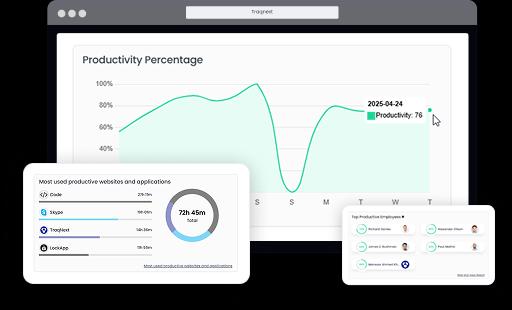
TraqNext gives managers a real-time productivity dashboard that shows exactly how remote teams are spending their time — which tasks are progressing, which apps are being used, and where idle time or workflow bottlenecks are occurring. This data allows managers to make targeted operational improvements without micromanaging individual employees.
Yes. TraqNext tracks task completion patterns, time spent per project, and app usage across teams. This data surfaces redundant processes, underperforming workflows, and resource imbalances — giving managers the evidence needed to redesign workflows, reallocate resources, and improve delivery speed.
A real-time productivity dashboard in TraqNext gives managers an instant, live view of team activity — who is working, on what project, for how long, and how productively. It replaces status meetings and manual check-ins with objective data, enabling faster, more confident operational decisions throughout the workday.
Updated October 5, 2026